 As mentioned in my previous post, engaging students through social action has always been one of my goals. This year, I set the specific goal of enhancing the learning side of Greenwood's service learning program by integrating community service with curriculum content.
So, when Amber and Aarom, my friends and fellow RERC members approached me this fall about conducting an "Urban Investigation" style program in my classroom, I jumped at the opportunity. Amber, Aaron and I had all been volunteers at the Center for Urban Pedagogy in Brooklyn, NY. It was here that we became familiar with the Urban Investigation model, inspiring us to break down classroom walls and use the city as a teaching tool.
I decided that the Urban Investigation model would be a perfect fit with my grade 10 Civics class, offering it as an option for students as part of their final project. As a team, we narrowed down a list of possible subjects for investigation, and decided that the revitalization of Regent Park would be the best way to connect with students and to provide an authentic audience for the final product.
We introduced the project and four eager students signed on to participate. Amber and Aaron went about setting up interviews with community stakeholders while I worked out the logistics on our end and prepped the students to ensure they were still meeting the same expectations of those students who opted to develop their own projects.
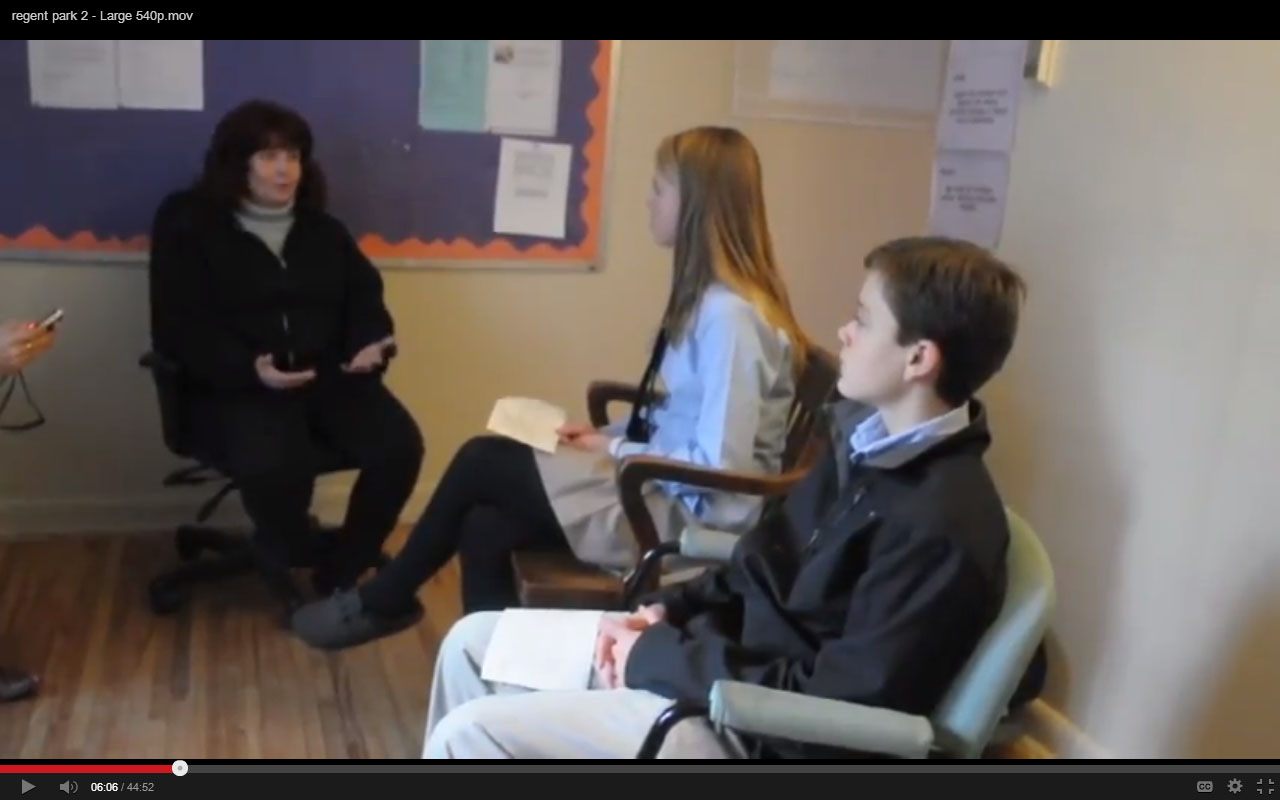
For five weeks, Amber accompanied the students to various locations in Regent Park during our class time. The students interviewed the principals at Nelson Mandela Public School, the Operating Unit Manager of the Toronto Community Housing Corporation in Regent Park, the head of the Regent Park Neighbourhood Association, the Executive Vice President of the Daniels Corporation, and a Criminology Professor at Ryerson University.
Each week, Amber and Aaron would work with the students on interview skills, helping them develop questions and follow up questions. The students took turns in the roles of interviewer, videographer, transcriber, and audio technician. After each interview, the students wrote reflections on what they learned and how it connected to the larger themes in Civics.
Following the interviews, Amber and I met the students at the public library on a Sunday afternoon for an all day video-editing and transcribing party. By the end, the students had chosen a theme, selected the best clips from more than five hours of interview footage, and put together a rough cut of a documentary called simply, The Revitalization of Regent Park. After a little editing in the following weeks, they had produced a 45 minute long film that fully explained the history of the neighbourhood, the process of the revitalization and many of the complex issues facing a community undergoing such a huge transformation.
In the end, the students all indicated that the project was incredibly informative and that they had a much deeper understanding of their city and the place where they have spent years volunteering.
A goal of the Urban Investigation model is to take what students learned and have them engage a wider audience on the issue. Therefore, the students decided they would show their film to all grade 7 and 8 students who volunteer every week in this community.
Working with the Coordinator of the Adviser program, we developed a series of prompts to help students reflect on their experience in the Regent Park Neighbourhood this year.
Next, we collaborated with the grade 7 and 8 social studies teachers to tie the content into their curriculum. The grade 8 students had been working a unit of study about land use and were moving into economics, so the content of the film fit perfectly with their learning goals for the unit. The grade 7 teacher was working on a unit of study about how Canada has changed over time and she was able to use Regent Park as an example for how Canada continues to change today.
The teachers showed the film to their students in class and then did a series of activities that connected to their curriculum. The project culminated in students writing blog posts for their portfolios, reflecting on the meaning of community service and what they have learned this year.
So What?
The feedback from the grade 7-8 teachers on this project was fantastic. They were surprised (as was I) to see how little students actually knew about the changes happening in Regent Park, the history of that community, and the basic premise of social housing. In hindsight, I see that this education should clearly be done at the START of the community service program in order to provide context for students as they conduct their volunteer service. The challenge will come in the form of carving out time in the very busy fall to focus on a project that involves multiple teachers and classes. However, now that I have a framework developed, I hope to move forward with this type of integration in the future.
Further Integration
Other areas where I have collaborated with colleagues to integrate service include:
Grade 11 Drama + Tokens for Change
Grade 11 Green Industries + Lord Dufferin PS
Grade 12 Green Industries + YMCA Academy
Various Music Classes + the Claremont and Briton House
Grade 12 English + Wallaceburg District Secondary School
As mentioned in my previous post, engaging students through social action has always been one of my goals. This year, I set the specific goal of enhancing the learning side of Greenwood's service learning program by integrating community service with curriculum content.
So, when Amber and Aarom, my friends and fellow RERC members approached me this fall about conducting an "Urban Investigation" style program in my classroom, I jumped at the opportunity. Amber, Aaron and I had all been volunteers at the Center for Urban Pedagogy in Brooklyn, NY. It was here that we became familiar with the Urban Investigation model, inspiring us to break down classroom walls and use the city as a teaching tool.
I decided that the Urban Investigation model would be a perfect fit with my grade 10 Civics class, offering it as an option for students as part of their final project. As a team, we narrowed down a list of possible subjects for investigation, and decided that the revitalization of Regent Park would be the best way to connect with students and to provide an authentic audience for the final product.
We introduced the project and four eager students signed on to participate. Amber and Aaron went about setting up interviews with community stakeholders while I worked out the logistics on our end and prepped the students to ensure they were still meeting the same expectations of those students who opted to develop their own projects.
For five weeks, Amber accompanied the students to various locations in Regent Park during our class time. The students interviewed the principals at Nelson Mandela Public School, the Operating Unit Manager of the Toronto Community Housing Corporation in Regent Park, the head of the Regent Park Neighbourhood Association, the Executive Vice President of the Daniels Corporation, and a Criminology Professor at Ryerson University.
Each week, Amber and Aaron would work with the students on interview skills, helping them develop questions and follow up questions. The students took turns in the roles of interviewer, videographer, transcriber, and audio technician. After each interview, the students wrote reflections on what they learned and how it connected to the larger themes in Civics.
Following the interviews, Amber and I met the students at the public library on a Sunday afternoon for an all day video-editing and transcribing party. By the end, the students had chosen a theme, selected the best clips from more than five hours of interview footage, and put together a rough cut of a documentary called simply, The Revitalization of Regent Park. After a little editing in the following weeks, they had produced a 45 minute long film that fully explained the history of the neighbourhood, the process of the revitalization and many of the complex issues facing a community undergoing such a huge transformation.
In the end, the students all indicated that the project was incredibly informative and that they had a much deeper understanding of their city and the place where they have spent years volunteering.
A goal of the Urban Investigation model is to take what students learned and have them engage a wider audience on the issue. Therefore, the students decided they would show their film to all grade 7 and 8 students who volunteer every week in this community.
Working with the Coordinator of the Adviser program, we developed a series of prompts to help students reflect on their experience in the Regent Park Neighbourhood this year.
Next, we collaborated with the grade 7 and 8 social studies teachers to tie the content into their curriculum. The grade 8 students had been working a unit of study about land use and were moving into economics, so the content of the film fit perfectly with their learning goals for the unit. The grade 7 teacher was working on a unit of study about how Canada has changed over time and she was able to use Regent Park as an example for how Canada continues to change today.
The teachers showed the film to their students in class and then did a series of activities that connected to their curriculum. The project culminated in students writing blog posts for their portfolios, reflecting on the meaning of community service and what they have learned this year.
So What?
The feedback from the grade 7-8 teachers on this project was fantastic. They were surprised (as was I) to see how little students actually knew about the changes happening in Regent Park, the history of that community, and the basic premise of social housing. In hindsight, I see that this education should clearly be done at the START of the community service program in order to provide context for students as they conduct their volunteer service. The challenge will come in the form of carving out time in the very busy fall to focus on a project that involves multiple teachers and classes. However, now that I have a framework developed, I hope to move forward with this type of integration in the future.
Further Integration
Other areas where I have collaborated with colleagues to integrate service include:
Grade 11 Drama + Tokens for Change
Grade 11 Green Industries + Lord Dufferin PS
Grade 12 Green Industries + YMCA Academy
Various Music Classes + the Claremont and Briton House
Grade 12 English + Wallaceburg District Secondary SchoolKeeping it Real: Regent Park Revitalization
As mentioned in my previous post, engaging students through social action has always been one of my goals. This year, I set the specific goal of enhancing the learning side of Greenwood's service learning program by integrating community service with curriculum content.
So, when Amber and Aarom, my friends and fellow RERC members approached me this fall about conducting an "Urban Investigation" style program in my classroom, I jumped at the opportunity. Amber, Aaron and I had all been volunteers at the Center for Urban Pedagogy in Brooklyn, NY. It was here that we became familiar with the Urban Investigation model, inspiring us to break down classroom walls and use the city as a teaching tool.
I decided that the Urban Investigation model would be a perfect fit with my grade 10 Civics class, offering it as an option for students as part of their final project. As a team, we narrowed down a list of possible subjects for investigation, and decided that the revitalization of Regent Park would be the best way to connect with students and to provide an authentic audience for the final product.
We introduced the project and four eager students signed on to participate. Amber and Aaron went about setting up interviews with community stakeholders while I worked out the logistics on our end and prepped the students to ensure they were still meeting the same expectations of those students who opted to develop their own projects.
For five weeks, Amber accompanied the students to various locations in Regent Park during our class time. The students interviewed the principals at Nelson Mandela Public School, the Operating Unit Manager of the Toronto Community Housing Corporation in Regent Park, the head of the Regent Park Neighbourhood Association, the Executive Vice President of the Daniels Corporation, and a Criminology Professor at Ryerson University.
Each week, Amber and Aaron would work with the students on interview skills, helping them develop questions and follow up questions. The students took turns in the roles of interviewer, videographer, transcriber, and audio technician. After each interview, the students wrote reflections on what they learned and how it connected to the larger themes in Civics.
Following the interviews, Amber and I met the students at the public library on a Sunday afternoon for an all day video-editing and transcribing party. By the end, the students had chosen a theme, selected the best clips from more than five hours of interview footage, and put together a rough cut of a documentary called simply, The Revitalization of Regent Park. After a little editing in the following weeks, they had produced a 45 minute long film that fully explained the history of the neighbourhood, the process of the revitalization and many of the complex issues facing a community undergoing such a huge transformation.
In the end, the students all indicated that the project was incredibly informative and that they had a much deeper understanding of their city and the place where they have spent years volunteering.
A goal of the Urban Investigation model is to take what students learned and have them engage a wider audience on the issue. Therefore, the students decided they would show their film to all grade 7 and 8 students who volunteer every week in this community.
Working with the Coordinator of the Adviser program, we developed a series of prompts to help students reflect on their experience in the Regent Park Neighbourhood this year.
Next, we collaborated with the grade 7 and 8 social studies teachers to tie the content into their curriculum. The grade 8 students had been working a unit of study about land use and were moving into economics, so the content of the film fit perfectly with their learning goals for the unit. The grade 7 teacher was working on a unit of study about how Canada has changed over time and she was able to use Regent Park as an example for how Canada continues to change today.
The teachers showed the film to their students in class and then did a series of activities that connected to their curriculum. The project culminated in students writing blog posts for their portfolios, reflecting on the meaning of community service and what they have learned this year.
So What?
The feedback from the grade 7-8 teachers on this project was fantastic. They were surprised (as was I) to see how little students actually knew about the changes happening in Regent Park, the history of that community, and the basic premise of social housing. In hindsight, I see that this education should clearly be done at the START of the community service program in order to provide context for students as they conduct their volunteer service. The challenge will come in the form of carving out time in the very busy fall to focus on a project that involves multiple teachers and classes. However, now that I have a framework developed, I hope to move forward with this type of integration in the future.
Further Integration
Other areas where I have collaborated with colleagues to integrate service include:
Grade 11 Drama + Tokens for Change
Grade 11 Green Industries + Lord Dufferin PS
Grade 12 Green Industries + YMCA Academy
Various Music Classes + the Claremont and Briton House
Grade 12 English + Wallaceburg District Secondary School