
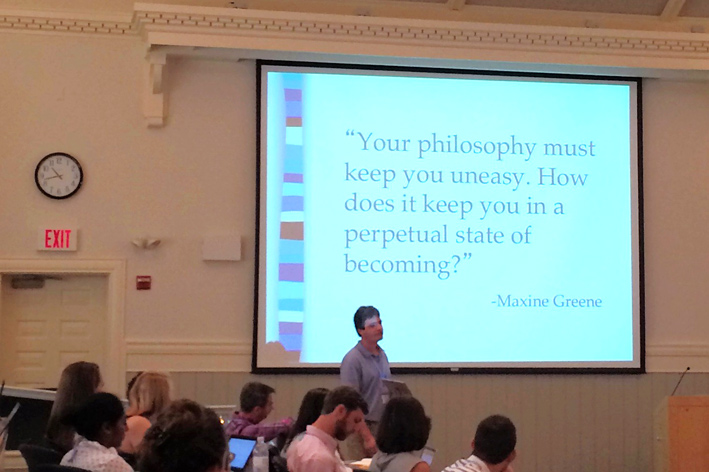
Dr. Pearl Rock Kane’s morning address foreshadowed this feeling: “We will complicate you."
Her speech itself unveiled the complexities that are present in the very foundation of the Independent School world in which we practice. Viewing the results from the school demographic survey, it became obvious that beyond just challenges we face in the classroom, schools are facing challenges on many levels ranging from financial solvency and managerial challenges to the “keeping up with the Joneses” mentality. For me, this discussion made it clear to me that the finances and personnel issues in an independent school can at times drive the mission and purpose of a school. Having good leadership will allow the opposite to happen. Unfortunately, we did not have time to explore these ideas further, although I hope that we will come back to them later in the program.Philosophy of Education Statement
From here, we dove into a meatier, practical exercise in philosophy (sounds like an oxymoron, I know). Donald Morrison, Institute Co-Director, introduced the morning’s activity in which we were asked to evaluate a colleague's statement on his/her educational philosophy. The process of thinking about our philosophy was designed to help us investigate the difference between theory and practice.
We were each asked to think about an ideal day in our own classrooms. A day when we left at the end of the day feeling “ah, that was a nice day.” We were prompted to think about:- What were the students in my class doing?
- What was I doing?
- What did the learning space look like?
- What was the assignment of the day?
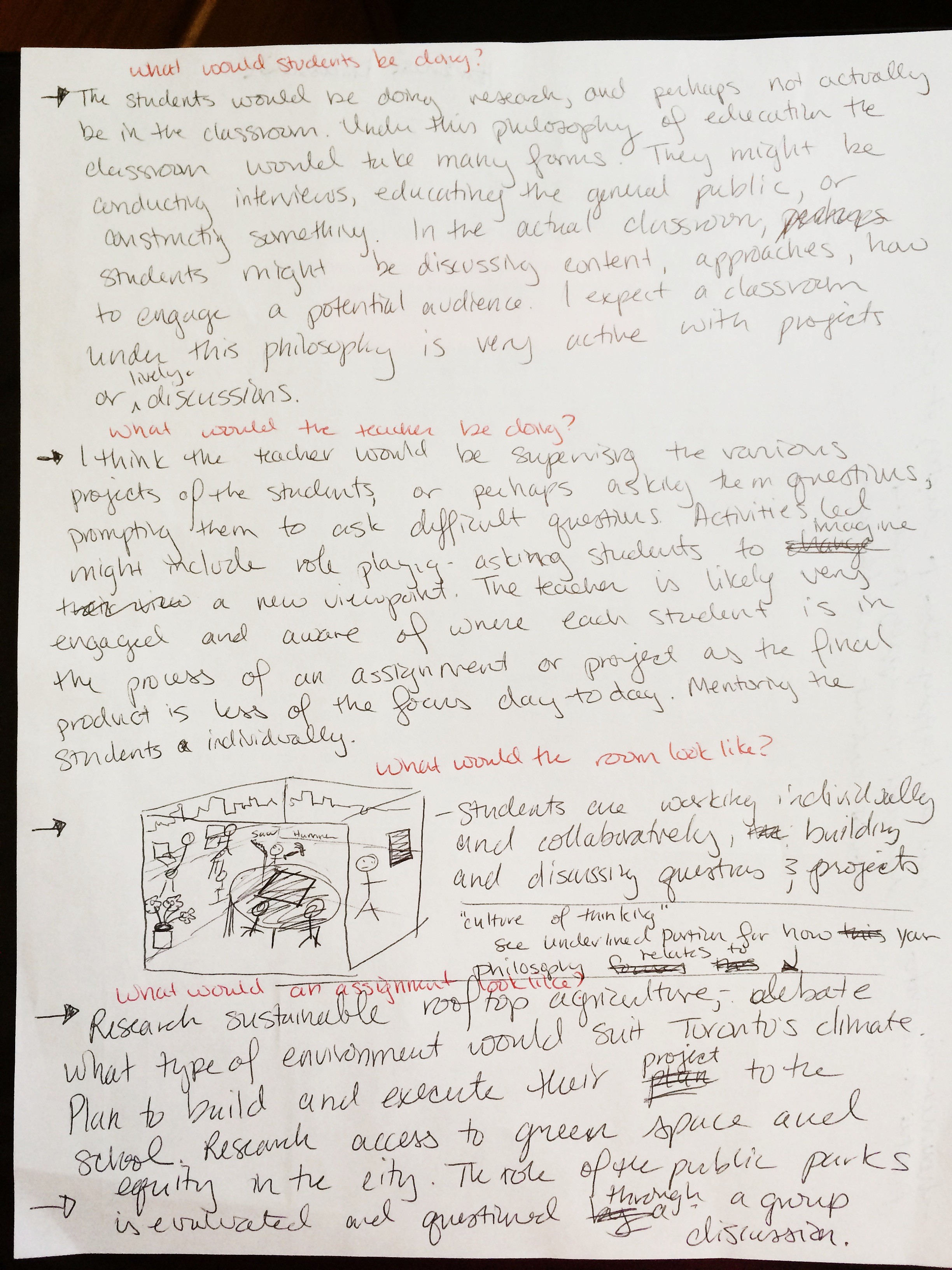 She guessed that my students would be doing research by conducting interviews (Revitalizing Regent Park documentary), educating the general public (Emerald Ash Borer Outreach assignment), or building something and perhaps not actually in the classroom (Lord Dufferin School Garden project).
- She thought that I would be supervising various projects at various stages and prompting the students with questions to deepen their understanding (The Indoor Farm Project running simultaneously with the Sustainable Farming Research Report).
- She predicted the classroom itself would be busy, possibly messy, and include computers, tools, and plants as well as images of the city posted on the walls (Have you seen my classroom?!)
- Finally, she concluded that a final project in my classroom would involve research on sustainability, perhaps a debate about the value of green space in a city (The Great Green Roof Debate), and a component that involves building something tangible, such as a school garden. She predicted that students would design their own projects and develop their own work plans (Choose Your Own Adventure).
Kelsey could not have been more accurate about my classroom, based on knowing the subject that I teach and by reading my Philosophy of Education Statement.
However, just because Kelsey made accurate assumptions about my classroom does not mean that my statement was fully realized; only that it was somewhat comprehensible. The real benefit in this activity was that in reading Kelsey’s statement, I was inspired to improve my own. She is a history teacher, and her statement included some thought provoking aspirations. For example, she focuses on getting students to ask tough questions (“What does it mean to be patriotic?”), to look at historical events from many perspectives (“What was WWII like for the Germans?”), and to learn to prove arguments using primary documents.
So, in reflecting on my own philosophy, I began to wonder how some of these goals can be applied to my own classroom, and how much of my philosophy is aspirational vs. practical. One thing that I know I can improve on is ensuring students are getting depth of knowledge that will challenge them to ask deeper and deeper questions. Due to the “newness” of the subject for many students, I don’t always ask them to dive too deeply into the subject. For example, because in Grade 12 Green Industries we are learning a variety of new hard skills such as drafting and model building, they don’t always “question everything” as I aspire them to in my philosophy. Another theme that continues to rise here at KSI is that of trusting that students can take on more challenges that we perceive them to be capable of. It would be effective to have the 12’s do a more thorough examination of how urban planning affects socio-economic divisions; how good design is democratic; what is the long term value of investing in cities?I could even apply historical thinking models to the investigation of cities by prompting students to question broader topics such as politics, economics, and social values as they apply to the design of cities. Later in the day, during my curriculum group meeting, I was sitting next to Gregory, who is designing a course on the history of urban planning, and he had plenty of ideas for me to incorporate historical thinking in my classroom.
Don ended the session with a final reflection question: “What are three values you want to impart to students and how are these values portrayed in your philosophy?
I see these values as citizenship (or belief in a common good), thoughtfulness (or the act of making decisions with intent), and the ability to value and empathize with others. How can I further weave these values into my philosophy?
I need to embed more tough questions into my courses. I ask broad questions about the value of public space and pose challenges that require students to be intentful in their thinking. But, I need to ask more questions about why things are the way they are? Why does design affect communities? Why does it matter? Why should we care about sustainable agriculture? I also need to give a lot more thought to the ideal of empathy. A lunchtime conversation with another teacher led me down a path of asking the question: “How do you really develop empathy in teenagers?” To which I had no good answer.
In the end, it seems as though Dr. Kane’s prediction was as accurate as Kelsey’s. It’s already getting complicated….
* To read the current version of my Philosophy of Education Statement, click here. It’s still a work in progress!
Great post Leslie! I think examining how your philosophy can hit the ground running, that is, how can you take big ideas and operationalize them is the crux of what we do. Also, it’s good to know that Don is still working his magic! Tell him I say hello; he was my inspiration… I enjoyed our runs together through campus!
Great work Leslie!
g.
Hi Garth,
Thanks so much for taking the time to read my posts. I will tell Don that you say hi. Let’s get together when I get home, I’d love to download with you and get your feedback on how we can bring these big ideas back down to a practical application in our classrooms.
Les
Les,
This is AWESOME! Congrats again for being accepted to this program and for making the most out of it already! I really appreciate this blog too; fantastic reflecting on your part and great summer reading for the rest of us to think big edu thoughts 🙂
In reading this post, I was particularly struck by your comment that “the finances and personnel issues in an independent school can at times drive the mission and purpose of a school”. I couldn’t agree more and I think this obviously holds significance particularly for our school, whose mission revolves around the notion of personalization. What does this mean for students in the classroom, outdoor ed, service learning and our adviser program? The answer is undoubtedly a lot, and I am very much looking forward to working together in three of those four areas next year toward sorting out a sharper answer.
I also felt a sense of familiarity around your concern that you are “ensuring students are getting depth of knowledge that will challenge them to ask deeper and deeper questions” and “trusting that students can take on more challenges than we perceive them to be capable of”. I think these thoughts resonate with a number of teachers in the Canadian & World Studies world. When you’re back, can we talk about exploring if this something that the Social Sciences and History departments could look at in conjunction next year?
Your idea to this problem by looking to employ historical thinking models is an excellent idea I think. The history team has looked closely at the Historical Thinking Concepts over the last few years (http://historicalthinking.ca/) and I will be attending a two day conference that is looking at how to more effectively assess these. Historical inquiry has very recently really moved forward in terms of better enabling the students to do deeper historical analysis with these concepts, but I think they have application (perhaps with some modification) to other subject areas. For example, I’m interested in establishing some continuity between Grade 10 Civics and Grade 12 Politics, but there could also be some interdepartmental work with Grade 12 World Issues there too. In my experience, work that asks students to integrate knowledge across and for different classes is always richer and demonstrates better depth. Again, I’d love to chat further on this when you’re back!
Anyway, just a few thoughts from my end. Thanks for keeping me sharp on the first weekend of summer holidays! Enjoy KSI 2014!
Best,
Charles
Thanks for taking the time to read the blog, Charles, and for the link on Historical Thinking Concepts. I will also share this with our history cohort and I’d love to talk more about this with you and Alex and Eugene.
If you’re interested in seeing what we are reading in the history group, here’s a link to a folder with the readings we have done so far: https://drive.google.com/folderview?id=0B6jaP_hpwCPwUWc0Rl9iVlluOWc&usp=sharing
I would love to talk more with you about the themes for History and Social Sciences next year. Digging deeper and trusting our student’s capacity are both themes that I’d like to explore in more depth. With all the cross-pollination between our teams, there are plenty of opportunities to collaborate and to formalize some big ideas for concentration next year. Let’s get together when I get home and share some ideas!
Hope you’re enjoying the first days of summer vacation. Thanks again for reading and for your thoughtful comments.
Les